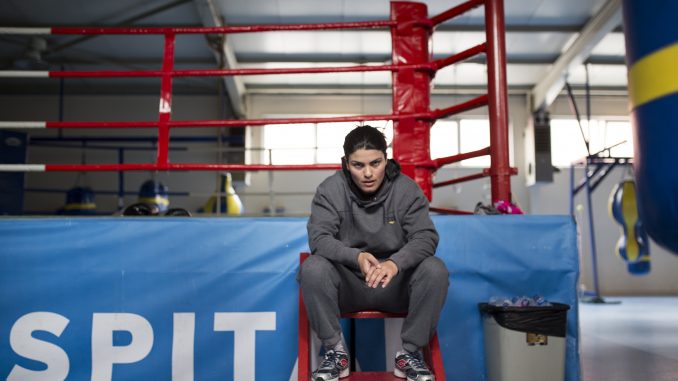
In the small, sleepy Belgian town of Roeselare, Gülsüm Tatar is about to step into the ring for the fight of her life. The Turkish boxer bounces on her feet, her jaw set and her face composed. With her coal black hair shorn at the back and sides and braided on top, she looks like a Mohawk warrior set for battle. Her name is announced, and she walks out into the lights, noise, and bombast of the arena to Major Lazer’s “Light it Up,” and climbs into the red corner of the ring.
Gülsüm’s fighting name is şampiyon—champion. Now thirty-four years old, she may be Turkey’s greatest-ever amateur boxer. After a long and illustrious amateur career, she became Turkey’s first professional female boxer two years ago. Tonight, February 16, a victory over the thirty-one-year-old Belgian fighter Oshin Derieuw—sixth in the world super-lightweight rankings—will catapult Gülsüm into the top ten and bring her a step closer to a major title fight. It is also another stage in her long struggle for recognition and respect for Turkish women’s boxing.
Oshin Derieuw comes next, soaking up the cheers from her two-thousand-strong hometown crowd, and steps into the blue corner. It’s set to be a tough fight; both fighters are unbeaten in professional boxing: Oshin with ten victories, Gülsüm three. They meet in the center of the ring, lock eyes, touch gloves, retreat to their corners. And the bell rings.
***
A few days before the fight, Gülsüm was involved in a blistering sparring session that surged back and forth over the sweat-stained floor of a small, ripe-smelling gym in Kadıköy, Istanbul. There was a row of heavy bags lining one wall, a pile of truck tires on the floor, and a small ring crammed into a dark corner—so close to the walls that fighters have to watch so they don’t bang their heads when they’re against the ropes. Gülsüm’s trainer urged her male sparring partner to hit her with more shots and more force. When the session ended, she sat on the floor, shiny with sweat, her chest heaving. As usual, she was feeling relaxed and confident.
Gülsüm was born in 1985 in Kars, in the cold, rugged far east of Turkey. Her family moved to Istanbul when she was a few years old. The harsh climate and high altitude in Kars produce many natural fighters, and boxing is in Gülsüm’s blood. Her uncle Kibar Tatar boxed in the 1988 Olympics. She grew up scrapping and wrestling with her four older brothers. Even so, boxing didn’t occur to her as something she would do. Gülsüm’s parents believed women should marry young and stay at home to raise children. They didn’t want Gülsüm involved in any sports, let alone boxing.
But when she was fifteen or sixteen, her brother Serkan—himself a promising boxer—began taking her with him to train at Fenerbahçe Boxing Club to keep her out of trouble and to use up some of her excess energy. She didn’t tell her parents. “The open-mindedness of my brother led me here to my life,” she said.
In general, Turkey is a patriarchal, conservative country, with a terrible record on gender rights and equality. Much of Turkish society might balk at the idea of women boxing, worrying that it is improper or too dangerous. But Gülsüm has always found acceptance in the boxing gym.
When she first started training, there were no other girls there, and the men treated her like any other fighter. She embarked on boxing’s brutal learning curve. When she took a sharp blow during sparring, she often couldn’t find the strength to fire back and, afterward, she would go and cry alone from the pain. Losing weight was hellish. But the frustration only made her more determined, and when her brother or a trainer gave her praise, her self-confidence grew and she craved improvement. She became stronger, her stamina increased, and she became a match for her sparring partners. Soon, she was lost to boxing. “When I could throw a punch properly, I felt like an immaculate, perfect person,” she said.
Click here to read the rest of the article published by Hannibal Boxing.
 Writing by Patrick Keddie