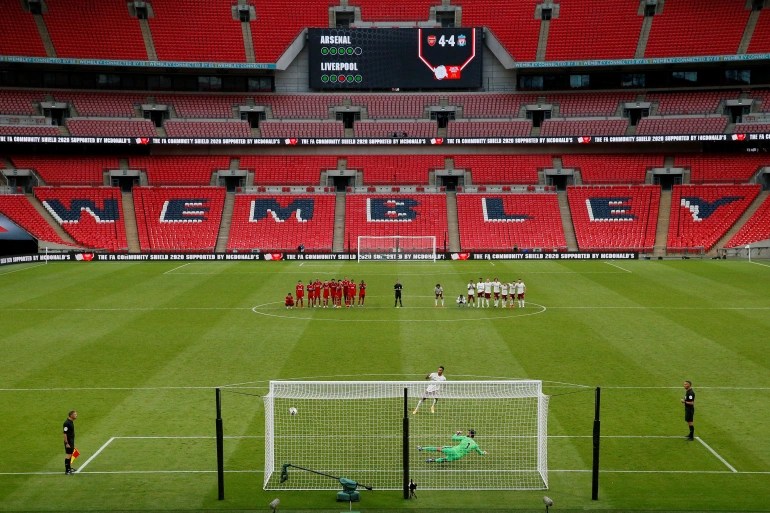
Empty football stadiums resound with their histories, argues Uruguayan historian and football fanatic Eduardo Galeano: “There is nothing less empty than an empty stadium. There is nothing less mute than stands bereft of spectators,” he writes.
His maxim has been tested repeatedly across the world this year, as football has been poleaxed by the pandemic.
“COVID has massively affected every aspect of football; from how the game is played, to how it is watched – with no fans, or restricted numbers – to the economics of the game,” journalist and author James Montague told Al Jazeera.
As COVID-19 spread rapidly in early 2020, nearly every professional league around the world was suspended.
Fans who were used to organising their lives around the regular rhythm and rituals of football matches were left with the option of rewatching old games or watching the likes of FC Slutsk take on FC Smolevichi-Sti in the Belarus Super League, the only European league to play on by late March.
Euro 2020 – with its particularly pre-pandemic friendly format of 12 host cities across the continent – was postponed to 2021, as was the Copa America.
“It’s been a big x-ray and it’s been a big wake up call,” said sportswriter, broadcaster and academic David Goldblatt.
“On the one hand, [it’s made clear] the deep and profound importance of football to innumerable numbers of people and its reliance as a spectacle and a social phenomenon on a real human crowd, interacting with the thing on the pitch,” he told Al Jazeera.
Read the rest of the article published by Al Jazeera English here.
 Writing by Patrick Keddie