Twenty years ago, the building that now houses Cercis Murat Konağı was a neglected old mansion sliding into dereliction in Mardin, a historic city in southeastern Turkey. Today, it is by many accounts the city’s most famous restaurant, with floor-to-ceiling windows that frame a panoramic view of Mardin’s honey-coloured rooftops and the patchwork fields of the Mesopotamian plain far below. In clear weather, you can even peer deep into neighbouring Syria.
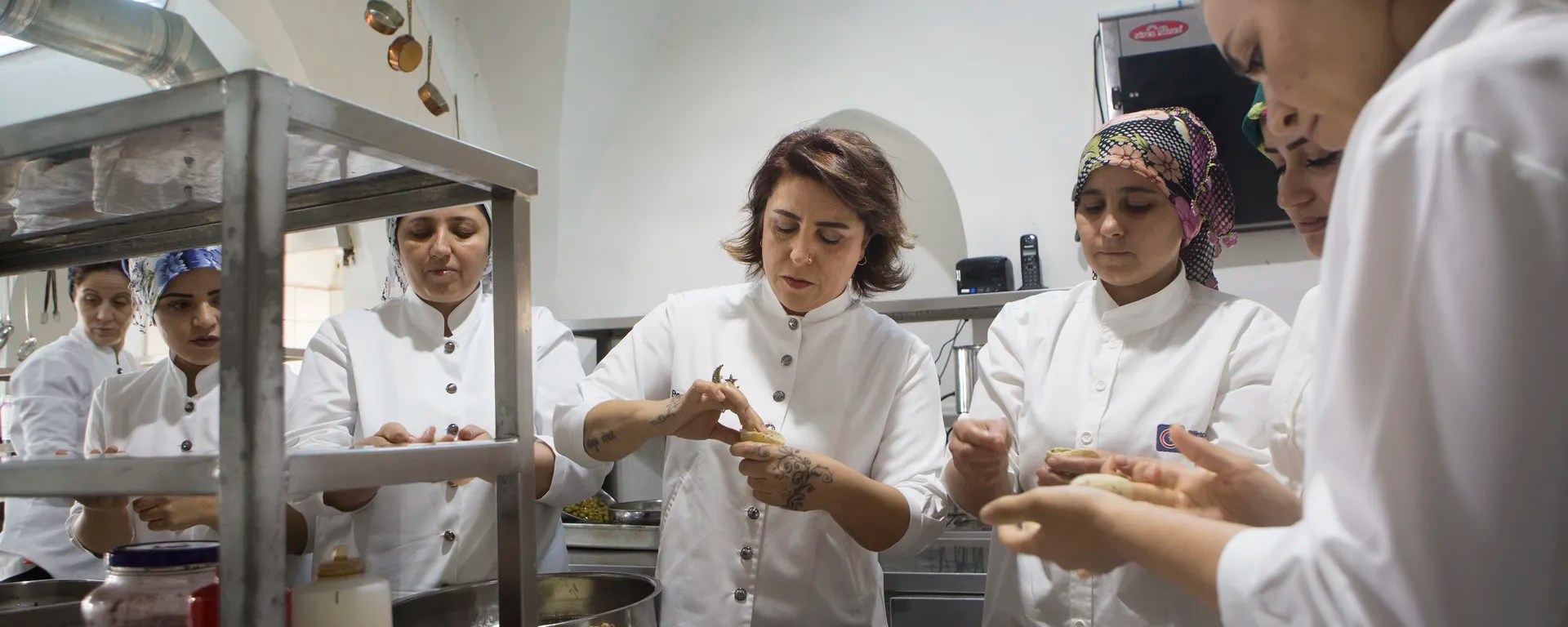
One morning in December 2018, Ebru Baybara Demir, the restaurant’s chef and owner, sat at a table in the dining room wearing a chef’s apron fixed with a Turkish star-and-crescent lapel. “Hos geldiniz [welcome]!” she greeted a reporter, photographer, and translator, beaming and extending a hand tattooed with twisting vines. Cercis Murat Konağı is at the heart of Demir’s wide-ranging work, which uses gastronomy as a means to give skills, confidence, and hope to vulnerable Syrian and Turkish women. By Demir’s estimation, she has trained some 200 women in her restaurant’s kitchen since it opened 19 years ago. “Some of the women are not educated; some are illiterate,” Demir told me. “But [here] they are professionals, they can earn money, and they can support their families.”
Demir’s efforts have earned her a reputation that extends beyond the borders of Turkey: She operates in the realm of TED talks, international conferences, high-level advocacy, and TV cookery shows, working up to 18 hours a day and hyperactively generating projects that teach skills such as baking, gardening, farming, mushroom cultivation, and literacy. As her profile has grown, so has the scope of her work. In the restaurant and in her other social projects, Demir initially focused her efforts on local women who were in dire straits, often mired in poverty, with large families to support. But since the outbreak of the Syrian civil war in 2011, she has increasingly concentrated on helping refugees from the nearly decade-long conflict.
The war’s unexpected turns, such as the US’s highly controversial military withdrawal from northern parts of the country last fall, as well as Turkey’s progressively perilous economic situation, have fuelled hostile attitudes toward Syrian refugees. Mardin itself isn’t immune to such sentiment: The city is largely impoverished, and some of its locals have greeted refugees, who number in the tens of thousands here, with resentment. Demir’s work has taken on increased urgency as a result, with her numerous ventures increasingly focused on creating harmonious, sustainable relationships within the region’s diverse population. “There is so much prejudice,” Demir said.
“Many Turkish people don’t want Syrians here. But we don’t know how much longer the war will continue, and we have to help these people.”
Read the rest of this article at Eater.
 Writing by Patrick Keddie